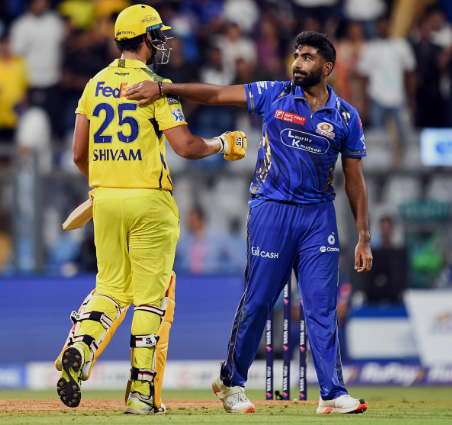
The rivalry between Mumbai Indians and Chennai Super Kings stands as one of the most intense contests in the Indian Premier League. Over the years, both teams have delivered unforgettable matches filled with pressure moments, tactical brilliance, and individual performances that shaped tournament history. From early encounters to high stakes playoff battles, every game has carried massive expectations from fans across the world. The battle between experience and aggression has defined this fixture, creating a unique cricketing narrative. This overview of Mumbai Indians Vs Chennai Super Kings Stats highlights the journey, records, and evolving dynamics that have made this rivalry a cornerstone of modern T20 cricket.
Recent Matches Table
Date
Venue
Winner
Margin
First Innings Score
Second Innings Score
Match Type
2 May 2026
Chennai
Chennai Super Kings
8 wickets
Mumbai Indians 159/7
Chennai Super Kings 160/2
IPL T20
23 April 2026
Mumbai
Chennai Super Kings
103 runs
Chennai Super Kings 207/6
Mumbai Indians 104
IPL T20
20 April 2025
Mumbai
Mumbai Indians
9 wickets
Chennai Super Kings 176/5
Mumbai Indians 177/1
IPL T20
23 March 2025
Chennai
Chennai Super Kings
4 wickets
Mumbai Indians 155/9
Chennai Super Kings 158/6
IPL T20
14 April 2024
Mumbai
Chennai Super Kings
20 runs
Chennai Super Kings 206/4
Mumbai Indians 186/6
IPL T20
6 May 2023
Chennai
Chennai Super Kings
6 wickets
Mumbai Indians 139/8
Chennai Super Kings 140/4
IPL T20
8 April 2023
Mumbai
Chennai Super Kings
7 wickets
Mumbai Indians 139/8
Chennai Super Kings 140/3
IPL T20
Team Statistics Summary Table
Metric
Mumbai Indians
Chennai Super Kings
Total IPL Head to Head Wins
21
20
Total CLT20 Head to Head Wins
1
1
Total Overall Head to Head Wins
22
21
Highest Score in Head to Head
219/6
218/4
Lowest Score in Head to Head
104
79
Total IPL Championship Titles
5
5
Most Recent Head to Head Victory
20 April 2025
2 May 2026
Individual Batting Records Table
Player Name
Represented Team
Match Innings
Total Runs
Highest Score
Batting Average
Strike Rate
Rohit Sharma
Mumbai Indians
30
913
105
33.81
131.25
Suresh Raina
Chennai Super Kings
32
736
83
28.30
141.53
MS Dhoni
Chennai Super Kings
35
710
63
36.80
130.40
Ruturaj Gaikwad
Chennai Super Kings
11
244
88
81.30
139.58
Suryakumar Yadav
Mumbai Indians
14
198
77
24.75
141.42
Tilak Varma
Mumbai Indians
8
175
51
29.16
134.61
Sanju Samson
Chennai Super Kings
2
112
101
112.00
181.15
Individual Bowling Records Table
Bowler Name
Represented Team
Total Wickets
Best Bowling Figures
Economy Rate
Bowling Average
Bowling Strike Rate
Dwayne Bravo
Chennai Super Kings
37
4/22
8.24
20.51
14.90
Lasith Malinga
Mumbai Indians
37
4/37
7.56
17.59
13.90
Harbhajan Singh
Mumbai Indians
26
5/18
6.82
25.50
22.40
Ravindra Jadeja
Chennai Super Kings
23
3/20
8.02
30.43
22.70
Mukesh Choudhary
Chennai Super Kings
7
3/19
8.33
21.42
15.40
Jasprit Bumrah
Mumbai Indians
7
2/20
7.45
28.14
22.60
Daniel Sams
Mumbai Indians
7
3/16
7.85
18.57
14.10
Early foundation of rivalry
The rivalry between two major Indian Premier League franchises began forming right from the early seasons when both squads were still shaping their identity. One side relied on experience, stability, and calm match control, while the other focused on aggressive intent and rebuilding through young talents. These early meetings were not just league fixtures but tests of pride and strategy. The contests often highlighted contrasting styles, one built around calculated pacing of innings and the other around explosive batting bursts and strong finishing depth. As seasons progressed, every encounter started carrying extra weight because both teams were consistently competing near the top of the points table. This phase created the emotional base of the rivalry where neither side wanted to lose even a single league game. Fans quickly started treating these matches as high intensity battles rather than routine league fixtures.
Season start
Top performer
Bowling impact
Match flow
Early phase
Senior batter
Spin control
Slow build
Early phase
Power hitter
Pace attack
Fast start
Early phase
Anchor player
Middle overs
Balanced
Early phase
Finisher role
Death overs
High finish
First encounter intensity
The first clash between these two sides immediately set the tone for what would become one of the most followed rivalries in the league. The atmosphere was charged even before the match began, with expectations of a closely fought contest. Senior players from both teams took charge, ensuring their teams stayed competitive throughout the innings. The batting approach from both sides reflected caution mixed with aggression, as neither wanted to give early advantage. The bowling units were tested under pressure, especially during middle overs where momentum kept shifting. The match also showed early signs of tactical battles, with captains adjusting field placements frequently. That first encounter did not just produce a result but also built a psychological edge that would influence future meetings. It became clear that whenever these two teams met, form and rankings would matter less than execution under pressure.
Opening phase
Key batter
Pressure level
Result shift
Power play
Top order
High
Even start
Middle overs
Spin unit
Medium
Slow control
Death phase
Finisher
Very high
Swing moment
Final overs
Lower order
Extreme
Tight finish
Leadership evolution phase
As seasons moved forward, leadership became the defining factor shaping the rivalry. One captain was known for calm decision-making and sharp tactical awareness in crunch situations, while the other developed a more aggressive and flexible approach to adapt to modern T20 demands. This contrast influenced how both teams prepared for each encounter. Field placements, bowling rotations, and batting order decisions often decided outcomes more than raw talent. Matches during this phase frequently went down to the final overs, where leadership under pressure became visible. The rivalry also saw captains trusting younger players in crucial moments, which sometimes resulted in unexpected match-winning performances. This phase marked a shift from pure star dominance to strategic cricket where planning and execution played equal roles. Every game started to feel like a chess match, where one small decision could completely change the direction of the contest.
Captain style
Tactical move
Key decision
Impact
Calm control
Field setup
Bowling change
Stability
Aggressive
Bat order
Attack plan
Momentum
Flexible
Rotation
Match reading
Balance
Risk based
Final overs
Death bowlers
Pressure
Playoff defining clashes
The rivalry reached another level when both teams met in high-pressure knockout games. These matches carried enormous stakes, where a single mistake could end an entire season’s campaign. Players who had performed consistently during league stages were tested under extreme pressure. Batters had to balance aggression with caution, while bowlers needed precision in every delivery. Several matches during this phase became turning points in tournament history, as momentum shifted dramatically within a few overs. Partnerships under pressure often decided outcomes, especially when early wickets fell quickly. The bowling attacks also became more strategic, focusing on restricting scoring zones rather than just taking wickets. These knockout encounters elevated the rivalry into a legendary status, making every future meeting emotionally charged for players and fans alike. The intensity of these matches is still remembered as some of the finest examples of pressure cricket in the league’s history.
Match stage
Star batter
Key spell
Pressure factor
Semi phase
Opener
New ball
High start
Mid innings
Anchor
Spin spell
Control phase
Late innings
Finisher
Death overs
Maximum tension
Closing
Tail order
Final over
Extreme pressure
Iconic last over finishes
Some of the most unforgettable moments in this rivalry came during last over finishes where the match result remained uncertain until the final ball. These situations tested not only skill but also nerves of steel. Batters attempted risky shots while bowlers relied on variations and slower deliveries to deceive opponents. Stadiums were often filled with silence before each delivery and erupted instantly after every boundary or wicket. These matches created heroes who performed under pressure and sometimes villains who narrowly missed execution. The unpredictability of such finishes became a defining feature of the rivalry. Even analysts struggled to predict outcomes as momentum swung rapidly within a few balls. These matches are still replayed by fans because they capture the essence of competitive T20 cricket at its highest level, where no lead feels safe until the final moment.
Final phase
Batter type
Bowling style
Outcome swing
Over 18
Power hitter
Yorkers
Balanced
Over 19
Finisher
Slower balls
Shift begins
Over 20
Tail support
Mixed pace
Final tension
Final ball
Any batter
Pressure ball
Result decide
Tactical evolution comparison
Over time, both teams evolved significantly in their approach to the game. One side leaned heavily on spin dominance and experienced players who could control match tempo, while the other focused on pace variations and aggressive middle order depth. Data analytics began playing a major role in planning strategies, helping teams identify opponent weaknesses. Matchups became more specialized, with bowlers assigned to specific batters based on historical performance. Batting units also started adapting flexible lineups depending on pitch conditions. This tactical evolution made the rivalry more complex and unpredictable. No team could rely solely on past records or reputation. Every match required fresh planning and real time decision-making. The increased use of match analytics added a new dimension where preparation off the field became as important as execution on the field.
Strategy type
Bowling focus
Batting plan
Outcome trend
Spin control
Middle overs
Anchors
Stable wins
Pace attack
Power play
Aggression
Fast results
Mixed plan
Death overs
Flexible
Balanced wins
Data driven
Matchups
Rotation
Adaptive play
Modern era and legacy
In the modern phase of the rivalry, both teams continue to evolve with younger players taking center stage. Experienced stars still play a crucial role, but emerging talent has added new energy and unpredictability to the contests. Matches are now faster, more aggressive, and heavily influenced by power hitting and innovative stroke play. Bowlers have adapted by developing variations to counter modern batting techniques. The rivalry has also expanded beyond the field, becoming a major talking point among fans across social media platforms. Every season brings new storylines, fresh matchups, and renewed excitement. Despite changes in squads and strategies, the intensity of the rivalry remains unchanged. It continues to represent one of the most competitive and emotionally charged matchups in the league, where history, pride, and performance always collide.
Modern phase
Young star
Skill type
Impact level
Power era
Batter
Aggression
High impact
Spin role
Bowler
Control
Medium impact
Death phase
All round
Balance
High impact
Final push
Finisher
Pressure
Game change
Conclusion
The journey between Mumbai Indians and Chennai Super Kings reflects consistency, resilience, and unmatched competitive spirit in the IPL era. Both sides have produced legendary performances, match winning knocks, and game changing bowling spells that continue to be remembered by fans. Each encounter adds a new layer to their historic rivalry, keeping the excitement alive every season. The balance of power has shifted multiple times, proving how closely matched these teams are in skill and temperament. Mumbai Indians Vs Chennai Super Kings Stats ultimately represents more than numbers, it captures emotion, legacy, and the true essence of elite T20 cricket competition.